Many people getting introduced to the Living Dead series don’t realize that Day of the Dead (1985) and Land of the Dead (2005) were originally supposed to be one feature. Romero wanted to conclude his zombie franchise on an epic scale; the final chapter of his proposed trilogy was to feature more full-blown action in the vein of Indiana Jones, complete with explosions, gung-ho soldiers and a Rambo-themed flavor (the treatment to the original 204-page screenplay was jokingly titled Old Soldiers Never Die – Satan Sends Them Back).

But during that time, Romero’s working relationship with Laurel Entertainment co-founder Richard Rubenstein was starting to turn sour. Although Dawn of the Dead and Creepshow were blockbuster successes (the latter was Romero’s first and only #1 box office opening), the non-horror film made in between by Romero, Knightriders – a tale of motor-biking knights of the modern age – was a massive box office failure. Rubenstein was looking for box-office stability, eventually turning to more mainstream ventures such as television shows like Tales from the Darkside, and Stephen King film adaptations like Pet Semetary.
To make matters worse, in trying to secure the budget for Day, originally set at least $7 million, Romero got hit with a major bombshell – financiers at distributor UFD demanded an R rating hoping to guarantee successful returns. If Romero wanted to do an unrated version, he’d get half that amount. An era of independent freedom was coming to an end, with the gloomy prospect of a new market-friendly studio system on the horizon. Heartbroken and knowing that any Dead picture he made just wouldn’t work without the uninhibited gore, Romero accepted the $3.5 million and shortened the screenplay, paring down most of the action sequences, eliminating some characters and setting most of the plot in a subterranean cavern doubling as a military/government complex.
Although higher budgeted than Night and Dawn combined, the film proved to be far less fun than Dawn, returning to the grimness, claustrophobia and total depravity that distinguished Night. The switch in tone didn’t work well with audiences who were expecting more of Dawn’s thematically audacious and humorous knockabout tone. Although it made a then-respectable $1.7 million dollar opening, the film was drowned out by the competition of The Return of the Living Dead, directed by Alien (1979) screenwriter Dan O’Bannon. Stuart Gordon’s Re-Animator followed later that year. Both Re-Animator and Return were revisionist takes on the genre that Romero himself created, with faster moving and more comedic living corpses. Contemporary critics were not kind to Day and viewer reception to this day is mixed, with people either hating or loving it for its dark approach and deviation from Dawn.

Boo! Sarah (Lori Cardille) gets a fright in Day of the Dead.
Yet Day of the Dead, despite its disappointing budget limitations and script changes is still a fine achievement. In fact, it actually looks far better today than when it was released. I admit that I was largely disappointed the first time I saw it at age 18 after just finishing Dawn, but managed to cut it a lot of slack after understanding the deeper and more intimate and philosophical focus of the material. And of course there were Tom Savini’s effects, hugely improved since Dawn.
The dead now outnumbered the living 400,000 to one, the power is out on the mainland, and “all the shopping malls are closed.” Civilization has officially come to an end. Our focus this time is on a female scientist, Sarah (Lori Cardille), as well as Jamaican helicopter pilot John (Terry Alexander), radio technician McDermott (Jarlath Conroy), and Sarah’s hysterical Puerto Rican boyfriend Miguel (Antoine DiLeo). They must reside with other scientists including Dr. “Frankenstein” Logan (Richard Liberty from The Crazies) and a redneck military unit led by tyrannical new officer-in-command Captain Rhodes (Joe Pilato). All live in a vast, Florida-based underground complex complete with old missile silo – really a “14-mile tombstone” where some zombie specimens are kept in a pen and brought out for study, usually with bloody results, while a growing crowd of zombies on the surface are held back from breaking into the complex by a locked fence.
Following the recent death of Major Cooper, Rhodes has taken command and imposes a brutal control over personnel and facilities facing depleting supplies. Sarah’s research is focused on finding a way to return the dead to their inanimate state permanently and begin civilization anew. However, her hopes for doing this are complicated by the domineering presence of Rhodes and his soldiers, as well as Dr. Logan’s new plans to tame the dead, starting with a loveable specimen named “Bub” (Howard Sherman in the film’s most indelible role). Meanwhile, John and McDermott plan to escape Rhodes’ tyranny and form a new society without the bigotry and other shortcomings of humanity, represented by Rhodes and his men. They’re attempting to persuade Sarah to come along, all while Rhodes’ hostility grows and Logan resorts to unorthodox methods to further Bub’s progress. All hell is about to break loose in hell itself…

Bub (Sherman Howard) catching up on some Beethoven in Day of the Dead.
Putting aside the aforementioned downgrading of action scenes and fast pacing, as well as a somewhat dated, offbeat synthesizer score by John Harrison, the film is mostly comprised of scenes of constant conversation paired with uneven pacing and an incredibly ugly tone. The film is largely devoid of Dawn’s sense of fun. Instead, this is replaced with a sense of escalating tension resulting in acts of racism and the looming threat of sexual violence and murder. This is a film about the world officially ending – the darkest in the saga – with an oppressive nihilism and claustrophobic atmosphere that surpasses the first two films. Thisis a depiction of civilized values collapsing in an apocalyptic crisis: “The Darkest Day of Horror the World Has Ever Known.”
Many critics complained about the acting being broad and over-the-top, but the film’s heightened performances are in keeping with the desperately hopeless situation of survivors losing their minds in a world that seems to have literally gone straight to hell. Even Logan, despite his supposedly rational behavior and attempts to talk Rhodes silly while civilizing zombie Bub belies a bleaker nature that stands totally opposed to Sarah’s ethics.
Visually – gore effects aside – Day largely succeeds in depicting a nightmarish reversal scenario, where the dead roam the surface while the living are largely confined underground, seemingly getting closer to the inner circle of Dante’s Inferno. On the surface, as beautifully conveyed by production designer Cletus Anderson’s authentic mattes combined with real locations of Florida’s Fort Meyers and Sanibel, the cities swarm with hordes of the dead in lighter clothing, with howling winds kicking useless cash about and weeks-old newspapers with headlines shouting “THE DEAD WALK!”

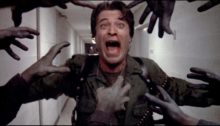
Captain Rhodes (Joseph Pilato) having a very bad day in Day of the Dead.
Back at the complex things are not much better. The soldiers and scientists live and work in cramped office spaces, while John and McDermott live alone in a separate trailer that’s not too far from the zombie pen. Bats flutter about, the darkness is mostly illuminated by white and red lights with plenty of dark spots for zombies to jump out from. The zombie pens seem to resemble slave quarters, while Logan’s lab facilities are filled with atrocities reminiscent of Joseph Mengele’s Nazi experiments during the Holocaust. The filming conditions took a toll on the cast and crew. For three straight months they saw very little sunlight and were plagued by sickness. Nonetheless, they managed to pull it off, with Romero generating a relaxed working atmosphere and even encouraging improvisation – the iconic scene in which Logan has Bub listen to Beethoven’s “Ode to Joy” on a Walkman was made up on the spot.
Looking at Romero’s film as a sociopolitical critique, Day succeeds as an indictment of what America faced during the 1980’s – the hypocrisies and damaging effects of the Ronald Reagan administration. The former actor-turned-President had begun his second term, and many perceived him to be far more belligerent this time around. After passing tax cuts for the wealthy whilst committing to reduce unemployment for the struggling classes, and cutting back on retirement programs such as Social Security Income, many were left distressed. There was also a perception that he was heightening the tensions of the Cold War by pouring billions into the Defense Department– all while advocating for world peace and discussing reductions in arms with Soviet Union leader Mikhail Gorbachev. Romero, as with The Crazies and his previous two Dead films, was unconvinced and disturbed by Reagan’s motives and methods. In Day of the Dead, The director makes the argument that any institution of power, whether government or military, is dangerous when given too much authority and power at the expense of logic and civilized values.

Sarah, meet Bub. Bub, Sarah.
It should be interesting to note that Day of the Dead resorts to using clichés from the 1950’s sci-fi B-movies that Romero grew up watching, namely the ideological conflict between the military and scientists on how to settle issues in a doomsday crisis. Prominent examples include Howard Hawks’ The Thing (1951) and The Creature with the Atom Brain (1955). But Romero subverts these clichés by presenting both sides as dysfunctional while using them to critique the views of Reagan.
The two sides of the President are presented here by its two main villains Rhodes and Logan, both opposites and equals. The bullying Rhodes demands total authority over what was originally a civilian team project to save civilization, converting it into a military operation. The American flag standing behind him Rhodes screams, “This is a fucking war! I’m running this monkey farm now… and if anyone fucks with my command, they get court-martialed. They get executed.” He eventually delivers on this promise. Logan puts on a more reserved “civilized” demeanor when trying to convince Rhodes that there is value in recivilizing zombies by rewarding social behavior “that enables us to communicate, to go about things in an orderly fashion without attacking each other like beasts in the wild.” But Romero suggests that like the “Great Communicator” Reagan, Logan’s approach to resolving the crisis is equally problematic. Both men, along with those easily manipulated by their monstrous leadership, must eventually perish. It’s far easier to sympathize with the zombies at this point, and cheer them on when the gory climax arrives.
With Romero’s Day of the Dead, the argument persists as it did in Dawn, that the future does not lie in institutions such as the government, military, religion, or the scientific community, but in the outsiders who are often shunned by “normal” human society. By observing its shortcomings, the outsiders eventually become more evolved and resourceful enough to flee the degenerate, doomed majority, starting a new civilization that will hopefully not repeat the mistakes of the old. Scientist Sarah is a strong, independent woman in the mold of the Alien saga’s Ellen Ripley. Pilot John brings a profound wisdom and denounces humanity’s sins like the John of Revelations. Human comic relief and radio technician McDermott is an elderly Irish immigrant much attached to his fellow outcasts. John’s helicopter is a contemporary Noah’s Ark, helping them to find sanctuary and salvation for the human race elsewhere.
Bub, meanwhile, is the only zombie with a soul. He’s also the true protagonist in Day of the Dead. He learns to obey Logan and they eventually form a very human bond, before Bub regains his autonomy and aids the attacking zombie hordes. Romero’s sympathies clearly rest with the living dead and the human outsiders.

Bub getting wise in Day of the Dead.
For all the scathing reviews that Day of the Dead received when it was released, most of the limited praise was certainly heaped on Tom Savini’s work as FX artist. Following his work on Friday the 13th, Maniac (both 1980), and Creepshow, Savini surpassed his breakthrough work in Dawn with some of the greatest practical FX ever seen on film. To this day he still considers it his masterpiece, and it’s easy to see why. With the help of a few apprentices – among them current FX kings Howard Berger and Gregory Nicotero – and with countless hours in a trailer devoted to throwing together improved latex appliance, fake blood, barbeque sauce and actual animal entrails in a seamless fashion, Savini turned Romero’s nightmares to vivid reality. He won the 1985 Saturn Award for Best Makeup Effects. Even today, in an era of CGI, these practical effects hold up stunningly well.
The film’s opening dream sequence shows zombie hands clawing their way out of a wall towards Sarah. The film’s title is superimposed below a city zombie with its bottom jaw missing and tongue dangling out. Logan’s first appearance comes complete with one zombie on an operating table with its skull removed and the brain exposed, while another zombie leans over with arm outstretched to spill its guts on the floor. The zombies have a furrowed caveman look, while Bub shaves the top layer of his skin with a razor. A soldier’s neck is torn by a zombie’s jaws. Miguel has his arm bitten, then chopped off by machete and cauterized by torch fire to prevent the spread of zombie-converting infection. And the finale, while not as comical as the mall raid in Dawn, is just plain epic. A screaming soldier has his head torn off by a zombie hand digging into the eye sockets. Rhodes has his legs and abdomen removed from chest and head (“Choke on ‘em!” being his famous last words) prior to the spectacular stomach-churning limbs-and-guts buffet that follows. This last scene in particular was filmed when the working conditions caused a failure in the fridge holding the animal guts; as a result they were rancid while being shot. It was a huge turning point for Savini, who would gradually find more projects to further his talent as an FX artist.
Day of the Dead was a turning point in Romero’s career as well. The director completed the project in order to fulfill and finish certain contractual obligations with Rubenstein. With most of his directing projects being pushed aside in order for Rubenstein to maintain financial stability at Laurel, and his disappointment in Day not becoming the epic he envisioned, Romero decided to experiment with Hollywood and take on some mainstream projects. Sadly, this would end up swallowing his career whole.
Two decades after Day of the Dead, he would pull his zombies out of retirement…
Comments
One response to “History of the Living Dead Part III: Day of the Dead”
My personal favourite of the Romero films. Not sure what that says about me 🙂