
Given what a wrinkly pile of junk the first one was, I have no right to be this excited. But the edition of Van Damme and Norris, plus the expansion of Willis and Schwarzengegger’s roles… I’m willing to grant this one an undue amount of anticipation. And I expect to be bitterly disappointed.
Month: August 2012

Judge Dredd’s back: No need to be Sly
Another case where the original film was so mediocre there’s no risk in trying again! Let’s hope this is a more respectable attempt at realising the British comic book hero, Judge Dredd.
Remake
Original

Room 237: Nutbags talkin’ Kubrick
 Another (slightly belated) review from the Melbourne International Film Festival.
As far as I’m concerned, there are two types of people in this world. There are those people who love Stanley Kubrick’s The Shining, and then there are those that the forces of the universe have placed before me in order to test the limits of my sanity.
As a teenager I remember being a huge fan of Stephen King, only to discover that he disapproved of Kubrick’s adaptation of his novel. How could this be? How could the minor populist talent that was King stand before the Grand Auteur and reject the honour that was bestowed upon him? It’s the equivalent of Da Vinci condescending to paint a portrait of Snoopy, only to be refused. Madness. Which it was of course, King’s criticisms were mainly steeped in a rejection of the ambiguities that made the film a masterpiece, and he also later approved of the schlocky TV adaptation directed by Mick Garris.
And so it is that the themes of madness and The Shining coalesce once again in Room 237. Room 237 is the first feature length documentary from Rodney Ascher, a fascinating film about the endless obsession of cinephiles with The Shining, and the tendency to over-read in its subtleties a plethora of complex and non-existent subtexts. The film is made almost entirely of footage from The Shining and other movies that are somehow meant to be related (the constant use of footage from Lamberto Bava’s Demoni is a bit of a stretch). The whole production is narrated a by a series of individuals who each have their own takes on what the “true meaning” of The Shining is. The most normal of these individuals could probably be best described as having an exaggerated belief in his case regarding the film, while the rest can be unanimously classed as totally and utterly insane.
I won’t go into detail on these individuals, but perhaps the most entertaining reading is that of a man who sees The Shining as a thinly veiled confession by Stanley Kubrick that he was responsible for helping the United States government fake the moon landing. Indeed, this man goes so far as to say that the visual techniques employed in the movie were clearly learnt while secretly filming the landing in a studio. Crazy stuff.
The whole movie is fascinating from start to finish for any cinephile, especially one who holds Kubrick in high esteem – however, this is in spite of the quality of the production rather than because of it. The reality is that listening to insane people say absolutely outrageous and largely unqualified things about a movie you love is inevitably going to keep your attention no matter what. It is this that saves this amateurishly produced documentary from falling apart. The footage chosen throughout the film is sometimes inappropriate, the sound editing was clumsy (occasionally the audio volume would drop drastically in one clip, only to return with a vengeance in another), and the movie could have done with interjections from individuals that might have provided a more sensible and enlightening textual analysis of the film.
But, so far as it goes, this is a film that should not be avoided by any Kubrick fan.

Red Dawn: Original and Remake trailers
Once in awhile, the boys and girls in Hollywood will elect to remake a trainwreck of a movie, because of the potential of its premise. The benefit is that there is nobody to offend with a subpar version of the original. This is the case with Red Dawn.
The remake
The original
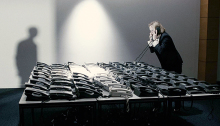
Carre Blanc: Evil guys with ties
 Another quick review from the Melbourne International Film Festival
Jean-Baptiste Leonetti’s first feature film, Carre Blanc, has been compared to such dystopian literary works as Aldous Huxley’s Brave New World and Orwell’s 1984, and even to Terry Gilliam’s masterpiece, Brazil. All of these comparisons are a little ambitious and beyond the reach of Leonetti’s film – a fairly decent entry into the dystopian genre.
Carre Blanc follows a couple living in a dystopian universe, a barely revealed world of corporate control and oppressive machismo. You know, people with ties casually bash people who don’t have ties, sometimes people with ties try to bash other people with ties, and then a small glimmer of human hope is revealed when somebody with no tie interjects. That sort of thing. People are being made into food for other people. The population is in decline for reasons never stated. Bleak stuff.
At the centre of the movie is a love story between a couple, Phillipe and his wife, who are being torn apart by his choice to embrace this fascist existence and climb to the top of the nightmarish corporate ladder – a decision made after his future wife saves him from a suicide attempt in his teen years. The viewer’s hopes rest principally on the possibility of Phillipe’s enlightenment.
It all seems to function at that very mechanical A-symbolises-B kind of level that often infects the dystopian genre with a diagrammatic hollowness. It’s not bad, but it’s not particularly interesting and only weakly echoes the greater works which have occupied this space.
The film looks incredible thanks to David Nissen’s cinematography. If you are a student of dystopian fiction/film then this one is worth a look.

