Month: June 2012

  • At the movies: Looking past the Popcorners and Noiseites

    At the movies: Looking past the Popcorners and Noiseites

    A recent article in a blog or newspaper (I can’t recall) on the social etiquette of cinema-going started me thinking about my own views on what is or is not acceptable within the realm of the movie theatre. It quickly became apparent to me that my views on the subject were militant to the point of absurdity, and I would have to review whether or not:

    • It was safe for somebody as authoritarian as myself to be allowed into a cinema;
    • It was worth my time going to a cinema at all, seeing as though I was bound to end up being violently enraged by some innocent human being who had the poor fortune to cough on an un-popped corn kernel during the most pivotal (and silent) scene in a film I’ve been waiting a year to see.

    I started off by making a mental note of some of the worse offences that can possibly occur in the cinema, some of which fit into the normal cinematic code of conduct, and some which most certainly do not. I chose the stream-of-consciousness rule here, and have attempted to catch my immediate emotional reactions to these violations. Here are three main categories of offences that I came up with:

    1. No talking. This seems like a simple rule, but a simple scratch of the surface reveals that there are a multitude of subcategories here:
      1. Obnoxious teenagers sitting at the back of the cinema that talk and laugh loudly through the movie between engaging in acts barely known to those of us born before the death of common decency. A lack of even the most minimal empathy with fellow human beings mean violence is the only solution here.
      2. Plot talkers who haven’t developed the normal cognitive ability to follow a film’s narrative. Usually of a more senior persuasion, these people are innocent of consciously violating cinema-etiquette. However, senility and ignorance are no excuse. These people should be banned from cinemas and all other cultural events that require the capacity for lateral thinking.
      3. The guy who uses sighs, seat-shuffling, and the “humph” sound to indicate that he believes the film you are watching is boring. In this situation, the movie is almost invariably a masterpiece and the culprit should be considered an enemy of the state… of EVERY state. (The other version of this is the giggler, who must laugh ironically at every scene that is not funny, just to ensure that their fellow audience members understand that they find the film to be ridiculous).
      4. People who need the film translated, or blind people who need to have the visual elements of the film described. These people are rare, and usually show up primarily at film festivals. In the presence of such individuals, all cultural sensitivities must be way-laid, to be replaced with a momentary contempt for everything that is different. (Keep writing Jim, confession is part of the growing process)
    2. People who eat instead of watch. These individuals most likely eat normally in every other situation in their lives, choosing only to move to feed-bag mode when in your auditory proximity. Whether they’re rustling through an obscenely sized bucket of popcorn, shuffling about in a deep packet of chips or slurping desperately on the last few drops of a two-litre Coca-Cola (half a gallon to my North-American cinephilic brothers and sisters)) like they were lost in the desert. I dream longingly of such an offender being found slumped in his chair, post-film, the world’s first victim of soft-drink (soda) drowning.
    3. People who invade my bubble. If you sit next to me in a movie theatre and feel that it is okay for us to be touching legs, arm, shoulders, or even clothing apparel, then it’s quite likely I’m already considering the possibility of pressing charges. Take note if you don’t want to be banned from walking within a hundred feet of your local primary (grade) school.

    Having completed this list I then had to answer the question: “Why do I go to the movies?” What is it that could possibly make me go through this process over and over again when with the slightest provocation the experience could be entirely ruined for me.

    The reason, of course, is simple. While I am prone to an excess of outrage every time I step into a movie theatre, there is an ironically social element to viewing a movie and enjoying it with a room full of human beings. When everything goes right, the big screen and surrounding darkness catch the audience and immerse them totally in the cinematic experience, elevating it beyond anything that could be experienced within the comfort of your own home. Comedies become funnier, thrillers become intense and horror becomes scarier when we are merged into a cohesive mass.

    There are few experiences like it, but the whisper of this social element can be seen elsewhere. Consider the moment when you realise that one of your old favourites is airing on television. You know that you’ve got it on DVD, you know that if you watch it on TV it will be interrupted constantly by commercials, but something about watching the movie on television and knowing that thousands, perhaps millions of others are sharing that exact experience at the same moment can become quietly comforting.

    So while I may moan constantly (and sometimes unfairly) about the inconvenience caused to me by individuals with whom I have shared the movie going experience, this is truly only because I find the experience to be so rewarding as to verge on perfection. Hundreds of strangers in one room, focused on one work of art, thinking and feeling together. Just don’t order the popcorn…
  • History and the movies: How to avoid telling lies and getting it wrong

    History and the movies: How to avoid telling lies and getting it wrong

    I have long held a fascination with the complex and chaotic relationship that cinema has with the representation of history. Since the earliest beginnings of humanity’s attempts at iconographic representation, we have endeavoured to tear the past from the vague and intangible clutches of memory and thrust it into the living present moment. Despite these efforts, which will not cease as long as people live and breathe, we are also acutely aware that such a process must ultimately end in failure. The past is the past and cannot be resurrected. All that we can do is assemble the artefacts and documents that time has left standing, and attempt to piece them together in the most accurate fashion that we possibly can.

    Of course, no book or film detailing the events of history is without erroneous details (many facts are inevitably lost to us) or misrepresentations of individual’s personalities and intentions (which can never truly be known). Nor can any book or film ever escape the trap of narrative – the process of distorting the infinitely complex real world into an unrealistic binary universe of cause/effect driven storytelling. This is not so much a fault as it is an inescapable truth of our relationship with the world.

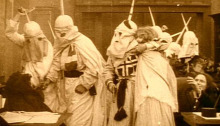
    It is also inevitable that the creator of a historical film or book will pass their own thoughts and ideologies into their work. One need only take a look at two films that deal with the same slice of history to observe the beginnings of ideological discrepancy. Consider the representation of the American Civil War in D.W. Griffith’s masterpiece/outrage The Birth of a Nation (1915) compared to the more contemporary and sentimental Glory (1989). One is a racist attack on the abolishment of slavery, and the other is an attack on racism and slavery itself.

    If we take the above points as an accepted fact in all films that deal with the past in one way or another (which I do), and accept them not as accurate representations of history but as inevitably tainted reconstructions of a lost past, then the films that come out on top are those that tackle this issue of lostness. In other words, films that acknowledge what they cannot know.

    One of the most impressive Hollywood directors to tackle this problem of historical representation is the New Zealand born Andrew Dominik. Dominik has thus far directed only three films in his career with a fourth on the way. The first is the Australian biopic, Chopper (2000), a brilliant film that details a portion of the life of Mark ‘Chopper’ Read, the Australian crime figure most famous for cutting off his own ears and a proclaimed love of torture. The second is the underrated biopic epic, The Assassination of Jesse James by the Coward Robert Ford (2007), a brilliant look at the distorting mythology of celebrity and its discordance with the real world. The third is a crime thriller, Killing Them Softly (2012). And the fourth is to be perhaps his most ambitious production of all, Blonde, a biopic on the life and times of Marilyn Monroe. Here, I’d like to focus on the first of the historical works that Dominik completed, Chopper (without ruining it for those who have not yet had the opportunity to view it).

    Dominik’s Chopper is an incredibly concise film, its narrative consisting predominantly of vignettes from various points in the life of a man who needs no introduction to Australian culture. Chopper has attained a level of celebrity in Australia akin to that of a contemporary Bonnie & Clyde, predominantly due to his self-declared love for blackmailing, torturing and killing drug dealers. First coming into the public eye in the mid-seventies when he took a courtroom hostage to force the release of a close friend, he now has a series of best-selling autobiographical books that detail his rather heinous career in graphic detail. Since Australia has laws prohibiting criminals from profiting from their crimes, he claims to only detail the events and acts that he has not been prosecuted for. Most people agree that the main reason he has not been prosecuted for these crimes is that they did not occur. But as Chopper is fond of saying, “never let the truth get in the way of a good story.” Combine this with the reality that the man has dealt with severe mental health issues his entire life and it quickly becomes apparent that getting to the core of Mark ‘Chopper’ Read is no simple task.

    And yet Dominik has chosen to undertake the difficult task of sifting through Chopper’s stories, police records and any source he could find to uncover the real Chopper. The result is a masterful film, shaped around the endless half-lies, lies, paranoid delusions and truths-made-to-look-like-lies that make the subject so inaccessible. Dominik demonstrates the difficulty of obtaining the truth of his character by having the viewer sit at a distance from the action, never quite able to ascertain the character’s thought process, or to fully comprehend what is or is not a lie. Indeed, Dominik presents the very real possibility that not even Chopper himself understands who he is or what he is doing. Perhaps the greatest achievement of the film is that the character does not come off looking two dimensional or entirely unsympathetic. Instead he is presented as an unknowable, loveable beast – as much a monster as a human being.

    The film’s incongruent scenes cover a large time-period in his life, often sitting chronologically distant from each other (at least in the first half) to avoid the viewer developing a solid narrative relationship with the character. This also serves the purpose of avoiding the aforementioned process of ‘distorting the infinitely complex real world into an unrealistic binary universe of cause/effect driven storytelling’. Many of the most famous moments of the character’s life are fleetingly referred to, and the characters in the film are often amalgamations of several individuals from the real world, highlighting the fact that this is not an accurate account of history, but an experimental grappling with the psychology of a significant Australian figure. The open titles indicate as much: “This film is a dramatization in which narrative liberties have been taken. It is not a biography.”

    The result of Dominik’s approach (and I am limited in what I can say by my unwillingness to spoil the film for future viewers) is a biographical study of a significant Australian figure that distances itself from the tainted obligations of biography and history in general. Dominik’s film is about the process of understanding and grappling with the past, without ever having the ability to truly know it.

    To finish off, here is one of the few scenes I could find online that didn’t compromise the film for those who hadn’t seen it. Enjoy…

  • Michael Parks: Crusty Genius

    Michael Parks: Crusty Genius

    As a teenager I developed an almost unhealthy obsession with the movie From Dusk till Dawn – most especially with one scene in particular. The scene in question featured a monologue from a crusty Texas lawman on the joys of alcohol abuse and the dangers of being served food by the mentally disabled. Aside from Quentin Tarantino’s beautifully crafted dialogue, the real joy of this scene lay in the actor’s gruff delivery, his craggy, weathered face, squinting eyes and thousand yard stare – all under the shade of a sheriff’s hat. The actor, of course, was Michael Parks – a man Tarantino once described as the world’s greatest living actor.

    It wasn’t long before I started seeing this actor pop up in other films, and his momentary presence seemed to increase the currency of a film immediately (for me anyway). I am perhaps the only person in the world who believes that his performance in Death Wish 5 ranks him amongst the all time greatest bad guys. I would be doing the man a disservice if I attempted to encapsulate his genius into words, so here are some clips from a few of my favourite Michael Parks films for your viewing pleasure (and filmic education).

    Kill Bill Volume 2

    Death Wish 5

    From Dusk Till Dawn

    Death Proof


  • Silly, Slimy and Offensive: The Heart of Gross-Out Comedy

    Silly, Slimy and Offensive: The Heart of Gross-Out Comedy

    Flicking through the usual assortment of reality shows, cop shows, cartoons and current affairs programs that littered the airwaves last night, I fell upon a film that has always induced an inordinate amount of rage deep within my heart. This film is by all measures silly and at least mildly offensive, which is of course the primary reason that it has received a cult following of some sort or other. The movie is the excremental Deuce Bigalow: Male Gigolo (Mike Mitchell, 1999).

    While I gazed in horror at this cinematic train-wreck, unable to look away despite myself, it occurred to me that there are a huge number of films that I’ve enjoyed because they are both silly and offensive. I started to list a range of movies that seemed to fit this rather loose criterion: Pink Flamingos (John Waters, 1972), Poultrygeist (Lloyd Kaufman, 2006), Straight to Hell (Alex Cox, 1987), Braindead (Peter Jackson, 1992) – the list went on and on. In fact, all the films in my list were far sillier and far more offensive than this poorly assembled mess of crass vignettes.

    Pink Flamingos contained obese middle-aged babies caked in egg bits, moments of extreme public exposure and concluded with a dining experience that was nothing short of… shit! Poultrygeist broke the boundaries of decency with borderline pornographic music numbers, poorly conceived racial caricatures and shots that redefined the concept of an extreme close-up. Braindead showed us what happens when a hundred men and women go through the ass end of a high-powered lawn mower. And Straight to Hell…. I suspect the editing process involved a blind-folded and intoxicated Alex Cox frantically snipping at the air with a pair of rusty scissors. These are the kinds of films you only put on once you’ve drawn the curtains – so what right did I have to complain about Deuce Bigalow?

    I started to think about what these films had that Rob Schneider’s tragic effort did not. What made me think of the final zombie massacre of Braindead (Dead Alive in the USA) with such affection? And then it occurred to me that the answer was (like in a million crappy paperback novels and junky telemovies) love!

    The films that I liked were made by auteurs of some type with a true passion for the grotesquery they were creating. Pink Flamingos was the result of John Waters being passionately engaged in counter-cultural filmic terrorism. Lloyd Kaufman’s life-long passion for the fringes of society collided with his contempt for global conglomerates in Poultrygeist. Peter Jackson’s Braindead was itself an ode to the glories of comedic gore and Straight to Hell was Cox’s inebriated journey into the bowels of his most beloved of genres, the western. Meanwhile, Deuce Bigalow was a lazily conceived piece of formulaic comedy, put together by the Hollywood factory to capitalise on the entrance of the gross-out comedy into the mainstream following the success of There’s Something about Mary (The Farrelly Brothers, 1998).

    I wasn’t offended by the fat jokes, the slights at the expense of the abnormally tall or any of the other misfortunate oddities that pervaded the film. I was offended at the grubby nihilistic nature apparent in every element of its production.  In the films I loved, the jagged messy editing that many of them shared seemed to enhance the exciting and frenetic freedom of excess – in Deuce, the messiness was the result of an incompetent craftsman in search of the standard generic form. In the films I cared about, the crassness seemed to be an expression of joy, whether in protest or mere celebration – and in Schneider’s vehicle it seemed that a marketing team had discovered inappropriate jokes at the expense of the less fortunate were currently popular with the teenage demographic. And in the movies I loved, the actors seemed to be as in love with the film as I did – not mailing it in to collect a cheque.

    At the end of the day, all I ask of a film is that the people making it actually care about the film they are making – and this time around, they didn’t. Sorry, Mr Schneider, but for me it’s all about the love.

  • How Michael Bay taught me to stop hating Spielberg and start hating Michael Bay

    How Michael Bay taught me to stop hating Spielberg and start hating Michael Bay

    As a young film student just out of school, I once shared the usual contempt that all serious film connoisseurs were expected to display for Steven Spielberg. From young students to senior lecturers, everybody I knew agreed that Steven Spielberg was the leading auteur of a kind of ‘lesser’ cinema, centred on spectacle, devastation and cheap sentimentality. In other words, he made blockbusters and blockbusters were bad.

    Of course, if Spielberg had produced films that were badly made, his contributions would have been received with less hostility. The thing that people truly hated about Spielberg was that he produced incredibly entertaining films, filled with convincing characters placed into situations that in a previous era would have been relegated to B cinema. These were spectacular works of escapist cinema that captured the attention of the public and did not concern themselves with exploring the human condition, the political clime, or any other subject deemed worthy of the form. More than this, whether one acknowledged Spielberg’s merits or not, his successes soon redefined what Hollywood cinema was about –many would say for the worse.

    After the success of Jaws (Spielberg’s first ode to the B-movies of his youth), the industry began to remodel itself with a much greater focus on what would soon become known as the ‘blockbuster’. These were films with a central focus on action and spectacle, and a lesser focus on narrative, character development and… well… anything that wasn’t spectacle. More than this, the studios progressively moved towards a marketing approach to cinema, with productions more often being structured in such a way as to satisfy various demographics. The result was a risk-averse industry, weary of films and filmmakers that moved far beyond standard generic formulae. That’s why a lot of people really hate Spielberg… he has long been seen as a marker for the rise of a shallow and more commercially driven cinema.

    Of course, from a business perspective the modern approach to film-production is understandable, businesses are designed to make a profit and the studios cannot be blamed for their attempts to produce a popular product. However, the tragic truth is that such an approach is also very restrictive on the creative possibilities of cinema. While one could argue that limitations and boundaries (commercial, generic etc.) can often result in great art, this is not so much the case when those boundaries include having to produce a film targeted towards men and women between five and sixty-five years of age that must be action packed, feature a romance, conclude with a happy ending and receive a PG rating from the censors.

    Michael bay and Jerry Bruckheimer are probably the epitome of this kind of cinema. They’ve dedicated themselves to the production of epic spectaculars starring young, attractive men and women playing two-dimensional stereotypes that spend their time kissing each other between explosions and gigantic robot battles that run for thirty minutes at a time – all of this is usually tied together by some kind of lazy and preposterous narrative that involves the potential end of the world at the hands of a robot or meteor or…. whatever. The cynicism with which these filmmakers approach their work is astonishing – but not as astonishing as the audience’s willingness to eat it up. However, it’s not Michael Bay’s films that break my heart – there is room in this world for crappy escapist cinema, it’s the fact that ninety-percent of Hollywood’s output is crappy escapist cinema and nobody seems to care. Compare today’s films to the cinema of the American New Wave and it becomes clear that the recent lamentations of many European critics are right – today, Hollywood only makes films for teenagers.

    Let me try and pull away from this grumpy rant so that I can get to the point – Spielberg isn’t an awful filmmaker, and he did not destroy American cinema. He is not to be held responsible for the unforeseeable consequences of his passionate love for the B-films of his youth, and his desire to share that love with the generations that followed. Every filmmaker strives for success and Spielberg succeeded. If his approach to filmmaking (and that of contemporaries, like George Lucas) resulted in an industrial shift towards a youth oriented cinema of spectacle then the responsibility lies fundamentally with the  industry itself and the tastes of the public.

    And at the end of the day, one need only look at the cinema of Michael Bay to fully appreciate the filmic talents of Steven Spielberg.

    Here endeth the grumpy rant.