“This place has a sign hangin’ over the urinal that says, “Don’t eat the big white mint.” – Wade Garrett
I’d like to take a quick moment to remember the frequently belittled classic, Road House (1989), featuring the underappreciated acting talents of the late Patrick Swayze, the brilliant Sam Elliot and the recently departed acting deity, Ben Gazzara.
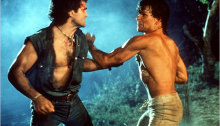
Despite the modern setting, Road House is a western at heart. Dalton (Patrick Swayze), a martial-arts expert, philosopher and the best bouncer in the business, is hired by Frank Tilgham to come to the small town of Jasper and clean up the obscenely violent Double-Deuce saloon. While in town, he falls in love with the stunning “Doc” (Kelly Lynch), a physician at the local hospital, who happens to be the former lover of the local tycoon, Brad Wesley (Ben Gazzara). Wesley, who also happens to be the supplier for the Double-Deuce, uses his small army of henchmen to make things more and more difficult for the saloon. The tables start to turn when Dalton is joined by Wade Garrett (Sam Elliot), train wreck alcoholic and Dalton’s bouncing mentor. Much excessive violence ensues.
At the time of its release, this gorgeous slice of 80s action was thoroughly lambasted for its unbelievable narrative, ridiculous dialogue, over-the-top performances and general air of clumsy excess. The film received an almost impressive five Razzie nominations for worst film, actor, supporting actor, director and screenplay, and received largely negative reviews that attacked its “malicious, almost putrid tone”[1] and dismissed its positive elements as accidental:
“Was it intended as a parody? I have no idea, but I laughed more during this movie than during any of the so-called comedies I saw during the same week.”[2]
“”Road House” is much funnier than most comedies, until it turns vile instead of just stupid.”[3]
I would contend that Roadhouse is not a malicious mess that occasionally crosses into so-bad-it’s-good territory, but a rather clever and self-aware piece of action cinema content to revel in, and celebrate, the conventions of the western and the action film while also winking affectionately at the audience.
It’s worth noting that the screenplay was written by David Lee Henry and Hilary Henkin. Henkin is the writer of Wag the Dog (1997), an incredibly cheeky film about an American president who has a spin doctor and a Hollywood producer team up to produce the illusion of a foreign war in order to hide the President’s more domestic issues. David Lee Henry, meanwhile, is the writer behind the Steven Seagal magnum opus, Out for Justice, considered by many aficionados to be one of the all-time great action films. With the combination of Henkin and Henry as writers, it’s hard to deny that the outrageous hilarity of Road House is anything but a deliberate stroke of genius.
A few tidbits to note, think about, watch for in Road House:
- Exactly how rich is Frank Tilgham, the owner of the Double-Deuce? Apparently he’s rich enough to replace every single glass, stool and table in the joint every. Single. day. The question is… where exactly does he store the backups? There’s no denying the carefree homage to the western saloon that is the Double-Deuce, home of the barroom brawl.
- What the hell is with Dalton and his so-called best friend Wade Garrett? From the moment that Garrett sees Dalton’s new girlfriend and announces that “that gal’s got entirely too many brains to have an ass like that”, it becomes immediately apparent that Garrett is a sleazy scumbag with every intention of taking a shot the first chance he gets… and she doesn’t seem too worried about it either. The uneasy relationship between these two friends might be the result of some kind of 1980s gender politics that I don’t get… but it makes Garrett endlessly fun to watch.
- How come obese people were so strong in the 80s? It was the only time that a 200kg (440 pound) man could play a tough-guy, AND stand a chance against Patrick Swayze.
- One of the funniest exchanges in the whole film involves one man presenting his girlfriend to other men, pulling her top down and declaring “You can kiss ‘em for twenty bucks.” At this point, one of the men reaches out and squeezes them for an inordinate amount of time before being asked “Well, ain’t ya gonna kiss them?” The response: “I can’t. I AIN’T GOT TWENY BUCKS!” Laughter and epic brawl follows.
- Brad Wesley, resident tycoon and bad-guy, has the incredible habit of never arriving at a location in the same vehicle more than once. Sure, we can accept the convertible and the four-wheeler motorbike, maybe even the helicopter, but the moment the monster-truck shows up you know you’re watching something special – especially when it drives through the local car-dealership without interference from the local authorities. Ain’t no law in the ole west!
- Brad Wesley doesn’t REALLY lose his scheizen until his dumb nephew gets fired from the Double-Deuce for stealing. Wesley… you’re a billionaire… WHY CARE?
- Thug says “What are you gonna do about it, dickless?” and then Garret says, “Well, I ain’t gonna show you my dick!” and then… HANG ON… what the hell does that mean? I don’t know and neither does the thug, but it doesn’t matter because three seconds later he’s a bleeding mess.
- After spending the majority of the film dealing out pithy philosophical one-liners like “Nobody ever wins a fight” as he pulverises every second person he sees, Dalton finally snaps and literally tears out the throat of an opponent in front of his new girlfriend, Doc. There can be no denying the rather disturbingly hilarious irony as both Doc and the audience come to terms with the fact that their hero is quite seriously disturbed.
- Just about the most inappropriately hard-core lovemaking/farg session of all time.
- How big is Jasper? It appears to consist of a saloon and a general store, yet Brad Wesley has somehow become a billionaire by exploiting the locals? Maybe he owns a railroad…
- The film ends with a heinous act of deplorable violence that I won’t reveal here, but the sitcom-style signoff that follows is a moment of pure genius.
There is no denying the glory of Road House.